WordPress category: CalendarConnect
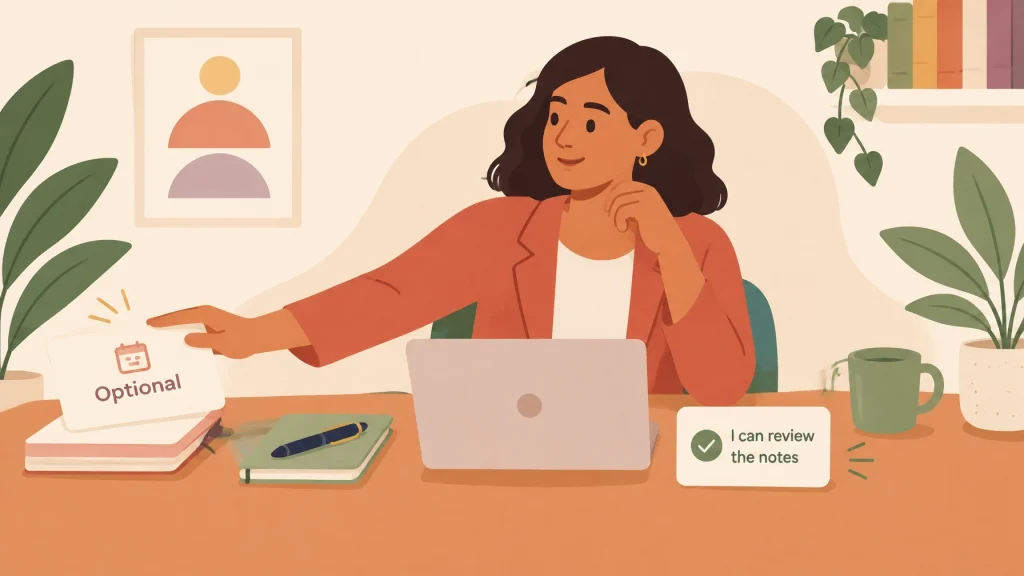
You can protect focused work without damaging relationships. The key is to decline the meeting, not the person, project, or shared goal.
A tactful “no” makes the next action clear. You can offer a written update, delegate to the right person, shorten the discussion, or reserve time for a meeting that truly requires collaboration.
That matters because meeting overload is also a calendar coordination problem. Every unnecessary invitation creates time spent reviewing, accepting, preparing, attending, and recovering from the interruption.
Microsoft’s 2023 Work Trend Index found that employees spend 57% of their time communicating through meetings, email, and chat, compared with 43% creating documents, spreadsheets, and presentations. The report also identified inefficient meetings as the top productivity disruptor. Read the original Microsoft research.
Saying no is not about avoiding teamwork. It is about making room for the work that requires your attention.
Decide whether your presence is necessary
Before declining a meeting, assess its purpose. Do not rely only on the title in the calendar invitation. Look for the decision, outcome, or contribution expected from you.
Ask five questions:
- What is this meeting supposed to accomplish?
- Do I have decision-making authority or relevant expertise?
- Does anyone need information that only I can provide?
- Is the issue urgent enough to require a live discussion?
- Would my absence affect the relationship or the outcome?
If the invitation does not answer these questions, ask for clarification before accepting.
A useful test is simple:
If I attend, what will be different because I was there?
If the answer is unclear, your attendance may not be necessary.
Research from Otter.ai and organizational psychologist Steven Rogelberg surveyed 632 U.S. employees across 20 industries. Respondents reported spending approximately 17 to 18 hours per week in meetings, while preferring to skip about 31% of those meetings. They declined only about 14% of invitations. Review the original report.
The gap suggests that many professionals recognize low-value meetings but hesitate to decline them.

Use a clear decision framework
A consistent framework makes your response feel professional rather than personal.
Attend when a live conversation is necessary
Accept the invitation when:
- You are a decision-maker.
- Your input will materially change the outcome.
- The topic involves sensitive relationship management.
- The group needs to resolve disagreement in real time.
- The issue is urgent and a written exchange would create delay.
- You are responsible for the next step and need to clarify ownership.
These meetings have a defined reason to exist. Your presence supports a decision, resolution, or important relationship.
Decline when your role is only informational
You can usually decline when:
- You are included for visibility only.
- The discussion is a routine status update.
- You have no decision rights.
- Another person can represent your team.
- The material can be reviewed independently.
- The meeting has no stated agenda or outcome.
That does not mean you should disengage. Ask for the notes, review the document, or provide your input in advance.
A practical response is:
“Thanks for including me. I don’t think I need to be in the live discussion, so I’m going to decline and protect time for the current priority. Please send the notes and tag me if a decision needs my input.”
The message is clear, respectful, and still connected to the work.
Decline with gratitude, clarity, and an alternative
A strong meeting decline usually has four parts:
- Acknowledge the invitation.
- State your decision directly.
- Give one brief reason.
- Offer a practical alternative.
Do not write a long defense of your calendar. Too much explanation can make a reasonable decision sound uncertain.
Use this structure:
“Thanks for the invitation. I’m going to decline because my input is not needed for the discussion. I’m happy to review the summary afterward and respond to any decisions that affect my work.”
Avoid vague phrases such as “I’ll try to join” when you already know you cannot contribute. A clear answer helps the organizer plan.
When you are protecting focused work
“Thanks for thinking of me. I’m going to decline so I can complete the deliverable due this week. Please send any decisions or action items afterward, and I’ll follow up if my work is affected.”
When the topic is outside your role
“I appreciate the invitation, but I’m not the right person to represent this area. I recommend inviting Jordan, who owns this work. I’ll decline so the discussion has the right participant.”
When you are included for visibility
“Since my role is mainly informational, I’ll skip the live meeting and catch up through the notes. Please flag anything that requires a decision from me.”
When the invitation arrives at the last minute
“I’m not able to join on this notice because I’m committed to a current priority. If the decision can wait, please send the key questions and I’ll respond in writing.”
These responses preserve cooperation without treating every meeting as mandatory.
Shorten the meeting when the topic matters but the format does not
Sometimes you should not decline the work, you should reduce the time required.
A meeting scheduled for 60 minutes may only need 15 or 30 minutes if the participants agree on the decision to be made.
Try:
“I can join for the first 20 minutes if we focus on the two decisions listed in the agenda. Would that be enough time?”
Or:
“I’m available for 15 minutes to resolve the open question. If we need a broader discussion, please send the background in advance.”
You can also propose a decision-only format:
“Could we use this as a 25-minute working session focused on scope, owner, and deadline? The remaining updates can go into the project document.”
This approach reduces meeting coordination cost while keeping the important discussion live.
Delegate without making the handoff feel dismissive
Delegation works best when you explain why the other person is better positioned to participate.
Instead of:
“I can’t make it. Ask someone else.”
Write:
“I won’t be able to attend, but Priya is leading the implementation and can answer the operational questions. I’ll brief her before the call and review the decisions afterward.”
A good delegate needs three things:
- The purpose of the meeting.
- The questions they are expected to answer.
- The decisions or follow-up they own.
If you delegate externally, confirm that the person has the authority to speak for your organization. That avoids a second meeting caused by unclear decision rights.
Convert status meetings into async updates
A meeting is often unnecessary when participants are only exchanging information.
Use an async update when:
- No decision is required.
- The information is stable and easy to document.
- Participants need time to review details.
- The same update can be shared with a wider group.
- The organizer mainly wants visibility.
A useful async update includes:
- Status: What changed?
- Progress: What is complete?
- Risk: What may cause delay?
- Decision needed: What requires input?
- Owner: Who is responsible?
- Due date: When is the next action expected?
You can suggest:
“This looks like a status update rather than a decision meeting. Could we post the update in the project channel and use replies for questions? I’ll review it by Thursday and respond to anything related to my work.”

The goal is not to eliminate communication. It is to match the communication method to the information need.
Protect the relationship when declining external meetings
Declining an internal meeting is different from declining a meeting with a customer, vendor, or partner. External relationships may require more context and care.
Before saying no, consider:
- Is this a first meeting?
- Is the other organization waiting on your decision?
- Has the partner already invested time in preparation?
- Is the meeting tied to a deadline, renewal, escalation, or deliverable?
- Could the decline be interpreted as a lack of interest?
If the relationship matters, offer a specific alternative:
“I’m not able to join at that time, but I do want to keep this moving. I can review the proposal in advance and join a 20-minute decision call later this week.”
When a meeting genuinely needs participants from different companies, scheduling can create its own delay. CalendarConnect helps you find mutual free/busy availability across organizations so you can identify workable times without extended email exchanges.
CalendarConnect only identifies mutual free/busy availability. It does not automatically send invitations, book meetings, or create calendar events. You still control the final meeting details and booking process.

Make your “no” easier to accept
People are more likely to respect a decline when they can see that you are protecting the outcome: not simply avoiding the calendar.
Use these habits:
- Respond promptly.
- Keep the explanation brief.
- Name the priority you are protecting.
- Offer notes, written input, or a delegate.
- Join when your decision or expertise is genuinely needed.
- Reconsider recurring meetings every few months.
- Ask for an agenda before accepting unclear invitations.
Asana’s 2023 Anatomy of Work Global Index reported that knowledge workers spend an average of 2.8 hours per week in unnecessary meetings. Senior leaders reported 3.6 hours per week. Read the original Asana research.
That time adds up across a team. It also creates coordination friction: more invitations, more rescheduling, more preparation, and fewer uninterrupted work blocks.
Replace automatic acceptance with deliberate participation
You do not need to accept every meeting to be a reliable colleague.
A thoughtful decline says:
- I understand the purpose.
- I know whether my contribution is needed.
- I respect the organizer’s time.
- I am offering another way to support the outcome.
Use a live meeting for decisions, relationships, disagreement, and work that benefits from real-time collaboration. Use written updates for routine information. Shorten the meeting when only one part requires discussion. Delegate when another person has better context or authority.
The result is a more focused calendar and better participation in the meetings that truly matter.
Ready to simplify how your team schedules across organizations? Try CalendarConnect free at calendarconnect.net